


The Syndicate and Its Operations
In a significant crackdown on cyber-enabled financial crime, the Dubai Police have dismantled a sophisticated syndicate responsible for a large-scale online trading scam that defrauded hundreds of investors across the United Arab Emirates. The operation, which was publicly announced in July 2025, targeted a gang that utilized a network of fraudulent trading platforms and shell companies to siphon millions of dirhams from unsuspecting victims.
The investigation, spearheaded by the Dubai Police’s Anti-Fraud Centre, was initiated following a surge in complaints from individuals who had fallen prey to the elaborate scheme. The scam was meticulously orchestrated, leveraging social media advertisements and unsolicited phone calls to lure victims with promises of high and quick returns on their investments. The funds, once transferred by the victims, were funneled into overseas bank accounts, making recovery efforts exceptionally challenging.
The bust of this syndicate has not only brought the perpetrators to justice but has also shed light on the alarming rise of such fraudulent activities in the region, prompting a renewed call for stricter regulatory oversight and enhanced public awareness.
Gang Composition and Arrest
The Dubai Police’s Anti-Fraud Centre arrested four suspects—three Jordanians and one Syrian—who were the masterminds behind the multi-faceted trading scam. The operation was part of the national #BeAwareofFraud campaign, emphasizing public education about cyber threats. The suspects have been referred to judicial authorities and face charges under UAE Federal Decree-Law 34/2021, with potential sentences of 7-12 years imprisonment, Dh 2 million in fines, and lifetime deportation bans.
The syndicate operated a complex network of fake trading platforms, primarily Gulf First Commercial Brokers and Sigma-One Capital, along with associated brands including DuttFx, EVM Prime, UTrade, EVA Markets, and Core Financial Markets. Gulf First operated from Dubai’s Capital Golden Tower, while Sigma-One claimed registration in St. Lucia. None were licensed by UAE financial regulators, yet they maintained professional-looking websites and trading dashboards to deceive victims.
Modus Operandi: The “Boiler Room” Approach
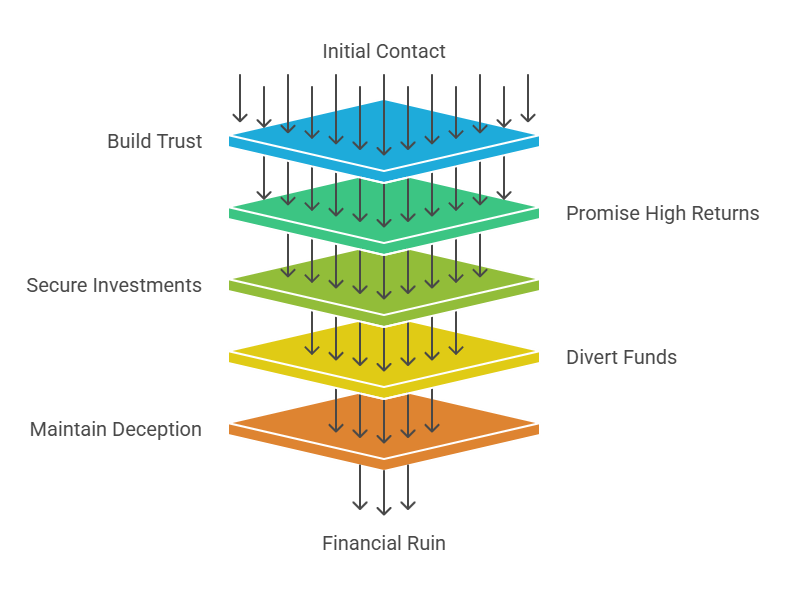
The syndicate operated through a sophisticated multi-pronged approach that combined traditional sales tactics with modern digital deception techniques. Their primary targeting method involved unsolicited phone calls and social media advertisements, where they posed as representatives of reputable investment platforms using unauthorized logos, branding, and fabricated testimonials to gain victim trust.
The gang used professional-looking social media ads promising high returns that linked to legitimate-appearing websites for victim sign-ups, while simultaneously cold-calling potential targets in their native languages to build rapport before launching rehearsed sales pitches. Their primary lure was promising high, quick profits – often claiming victims could double or triple investments within weeks – supported by fake trading statements and testimonials that specifically targeted financially struggling individuals seeking income supplements.
Once investments were secured, the syndicate immediately transferred funds to overseas bank accounts through a network of shell companies and offshore accounts, making recovery nearly impossible and placing assets beyond UAE law enforcement jurisdiction.
This final step in their “boiler room” scam with a modern digital twist ensured the gang’s success while guaranteeing victims’ financial ruin, as the overseas fund diversion made it extremely difficult for victims to trace or recover their money once they realized they had been scammed.
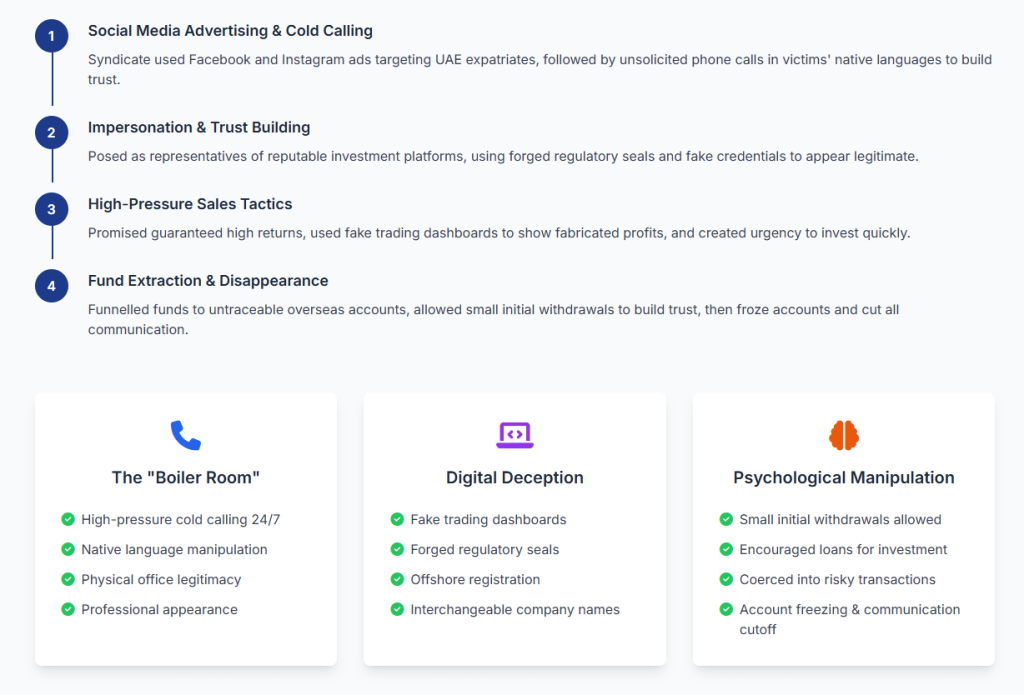
The Capital Golden Tower office functioned as a high-pressure call center operating two shifts daily. New hires received 48-hour training in “conversion psychology,” learning to use hook stories, trust anchors (fake DFSA license numbers), and scarcity closes. Representatives averaged 312 calls daily using VoIP lines that cycled caller IDs every 90 minutes. Native-language speakers targeted specific demographics, achieving a 4.3% conversion rate – triple the legitimate industry average.
Victims received bespoke client portals cloning MetaTrader 5’s interface, fed by dummy price servers in Moldova. The gang maintained 42 mirror domains with duplicate content and different IP addresses. A cron job refreshed news widgets every 30 minutes by scraping Reuters headlines, while RSS icons downloaded malware capable of key-logging banking credentials.
The final layer was a “confidence cycle” designed to last 45-60 days.
| Week | Milestone | Purpose |
| 1 | €250 “starter bonus” credited instantly | Overcome inertia, test payment rail |
| 2 | €1,000 withdrawal approved within 24 h | Cement trust, generate word-of-mouth |
| 3-4 | Account manager introduces “leveraged turbo” product | Upsell 3× initial capital |
| 5 | Fake margin-call: market “gaps” 400 pips overnight | Coerce top-up to “save” position |
| 6 | Account frozen, compliance demands notarised KYC | Buy time while last wire is confirmed |
| 7 | All channels go dark | Exit |
Victims who threatened to report the firm were sent a **deep-fake video**—created with an open-source lip-sync model—showing the “head of legal” citing UAE Federal Law 34 of 2021 and promising that any charge-back would be met with a counter-claim for defamation. The clip was personalised: the victim’s name appeared in the footer of the falsified court document held up to the camera. Police forensic analysts later matched the background to a green-screen studio filmed in the same Business Bay office.
Financial Impact & Victim Profile
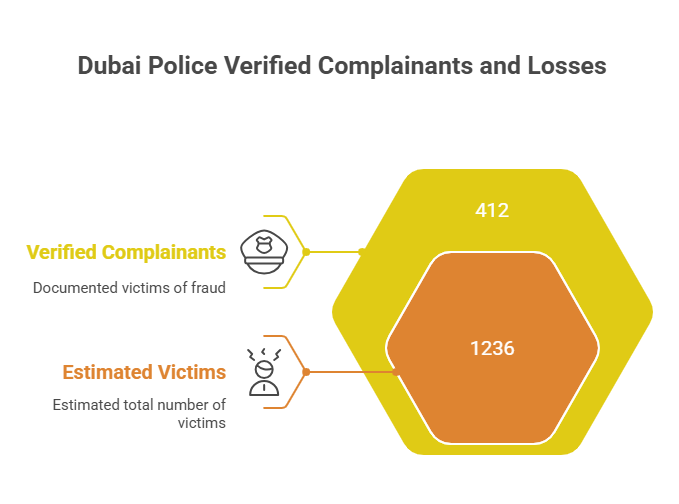
Dubai Police documented 412 verified complainants with combined losses of Dh 186 million (US $50.7m). Investigators estimate only one in three victims files complaints due to shame or visa concerns.
Victim Demographics
Heat-maps revealed two dense clusters:
- Al-Nahda/Qusais corridor (mid-income South-Asian renters)
- Marina/JLT towers (young Western expats with trading experience)
Median individual loss: Dh 450k. Notably, 68% of victims had previously used regulated brokers (eToro, IG, Saxo), providing the gang with pre-qualified leads scraped from LinkedIn.
Case Examples
- Ramesh K., 38, Uber driver: refinanced his Honda Accord for Dh 95k, lost everything in 11 days
- Sara A., 29, Egyptian dentist: lost Dh 630k from her father’s mortgaged apartment for wedding funds
- Ahmed & Mariam, retired Emirati couple: transferred Dh 1.8m end-of-service gratuity after viewing fake Instagram content
Legal Aftermath & Regulatory Response
Criminal Proceedings
The four suspects face charges under Articles 11 (electronic fraud), 14 (money-laundering), and 40 (impersonation of official bodies). Dubai Public Prosecution is testing extraterritorial subpoenas under Article 17, requesting account freezes from St. Lucia’s Financial Intelligence Unit and Georgia’s central bank—potentially creating the first GCC precedent for offshore crypto-asset repatriation without bilateral treaties.
Regulatory Reforms
DFSA “White-List” Reform: Within 72 hours of arrests, DFSA launched a public API returning JSON objects for firms claiming Dubai regulation. UAE Banks Federation now auto-blocks transfers to unlicensed domains.
SCA Social-Media Protocol: MOUs with Meta, TikTok, and Telegram enable removal of cloned brand pages within two hours of DFSA confirmation. Since July, 1,300 fake profiles have been preemptively removed.
Mandatory Segregated Escrow: A draft cabinet resolution proposes UAE-facing brokers must hold client money in independent, UAE-central-bank-audited escrow accounts funded at 120% of client liabilities—effectively eliminating the “vanishing broker” model.
Bottom Line: Checklist On How Not to Be the Next Victim
- Verify, then trust: Paste the exact company name into dfsa.ae/verify and sca.gov.ae/entity-search. A single mismatch means walk away.
- Rejection test: If the rep resists a video call in which you demand to see their Emirates ID and DFSA individual licence, hang up.
- Payment rail rule: Legitimate UAE brokers accept local bank transfers to UAE-dirham-denominated, CB-licensed accounts. Any request to send USD, USDT or to an IBAN starting with LC (St. Lucia) = red flag.
- Profit-pressure metric: Promises of >18% annual return are automatically flagged by UAE consumer-protection algorithms. Treat anything higher as fraudulent until proven otherwise.
- 30-minute cooling-off: Before wiring money, screen-record the entire sales pitch and send it to fraud@dubaipolice.gov.ae for a no-questions-asked sanity check; replies arrive within two working hours.